When asked to cite an example of eugenics in modern society, the first thing that comes to mind is Nazi Germany. This infamous example of mass racial cleansing is familiar to most students by the time they enter junior high. But despite the relevance and pervasiveness of the Holocaust to the subject of eugenics, not many people know about the eugenics environment of the time or how it influenced Hitler to eventually cause the Holocaust.
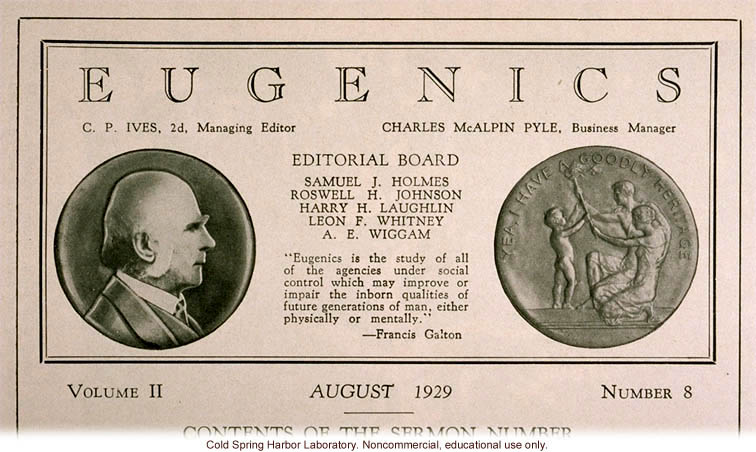
The term “eugenics” was first coined by Charles Darwin’s cousin, Sir Francis Galton, in 1883. He originally used it to encourage high-ranking families to marry each other to increase their status and worth. Before long, however, the term came to represent the proliferation of superior traits by slowly weeding out unfavorable traits such as decreased mental ability or drunkenness. The idea was that humans could be bred like animals in order to produce fitter individuals.
In the late 19th and early 20th centuries, Europe, especially Germany, was seeing an increase in immigrants from other nations. The Germans resented the invasion of these foreign people, and viewed them as different and less worthy to be living in Germany. Because Darwinism was popular at the time, many Germans feared that these immigrants would out-reproduce the native Germans and pollute the gene pool with undesirable traits. Thus it was in the Germans’ best interests to encourage the mating of the fit with each other, and at the same time to discourage the unfit from mating.
In 1905 the German Society for Racial Hygiene was established in order to facilitate the deletion of unfit traits. Using eugenics as its cornerstone, the Society hoped to purify the German population of the undesirable traits that had been brought by the immigrants. The Society slowly began to expand, and by the 1920s there were branches all over Europe as well as in America. Because most of Germany was united behind this common goal, the Society had a lot of political influence and was responsible for making changes in laws that directly affected individuals’ reproductive fitness, including forced sterilizations and marriage restrictions.

German poster promoting racial hygiene.
Forced sterilization laws were already common practice in the United States by the 1920s, and many eugenicists in Germany looked to the US as a model for how to implement eugenics in their own society. Also around this time Hitler began to gain a wide influence in German politics. In his autobiography, Hitler states that he drew a great deal of influence from the eugenics movement in America. The eugenics writings of authors such as Madison Grant and C. M. Goethe inspired in Hitler the desire to cleanse Germany of all unfit individuals in order to purify the gene pool.
For Hitler, eugenics was a way to rationalization the sterilization or death of unfit individuals. By citing pseudo-scientific sources, Hitler was able to make racial hygiene seem like a legitimate scientific concept, and thus naturally justified. He managed to convince many Germans to take up his cause by wrapping eugenics in a medical and scientific façade.
In the years leading up to World War II, Germany was already well on its way to eliminating those deemed unfit to reproduce. By 1935 Germany had both forced sterilization laws and euthanasia programs, including the famous Action T4 program in 1938. These programs killed individuals who were judged unfit for life, such as the mentally retarded or handicapped. Proponents of these programs argued that the mentally ill cost a large amount of money to take care of, while contributing nothing worthwhile to society. It did not take much to extend these programs one step further to killing those who did not meet Hitler’s racial and hereditary standard. These ideals and the entire eugenics movement eventually came to a climax during the Holocaust, in which millions of innocent people were killed in the pursuit of a perfect race.

“60 000 Reichsmarks is how much this mentally handicapped person will cost society throughout his life. Citizens, this is your money too. Read "New People" - The monthly magazine of the office for race policy of the NSDAP – 1938”
The most disturbing aspect of the eugenics movement is that no one seemed to have a problem with the weeding out of unfit individuals in order to produce a superior stock of humans. When viewed through the filter of today’s society, where human rights groups defend the worth of all individuals, the eugenics movement seems like a gruesome and unsettling splotch on human history. Yet at the time, it seemed like a totally normal and natural idea. Even those who had no scientific background supported eugenics, entering in Better Baby contests and proudly displaying their pure heredity. No one questioned the motives behind eugenics or thought to reflect on how it could turn negative quite rapidly if used by the wrong person.
The history of eugenics brings up an important idea—the blind acceptance of scientific theories. Like phrenology before it, eugenics has no basis in actual science, but parades around as if it is natural and right. Both of these concepts swept up the populations of their times and caused a revolution in the judgment of others. Once these were critically analyzed, however, it became clear that neither had much evidence supporting them. I would like to think that individuals today are more educated than they were in the past, and will not accept “revolutionary” ideas as readily. Regardless, it is still crucial to be skeptical of new ideas that appear to be scientific without any real proof. If everyone uses a little common sense and acts inquisitive towards emerging scientific theories, it is possible to prevent tragedies such as eugenics from occurring again.

No comments:
Post a Comment